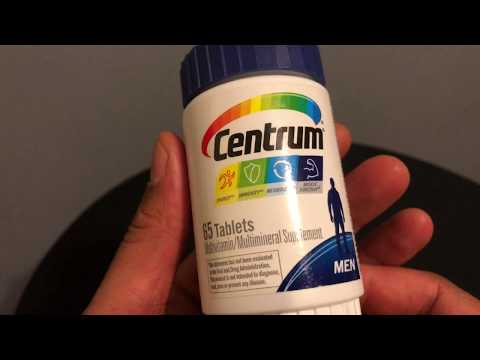
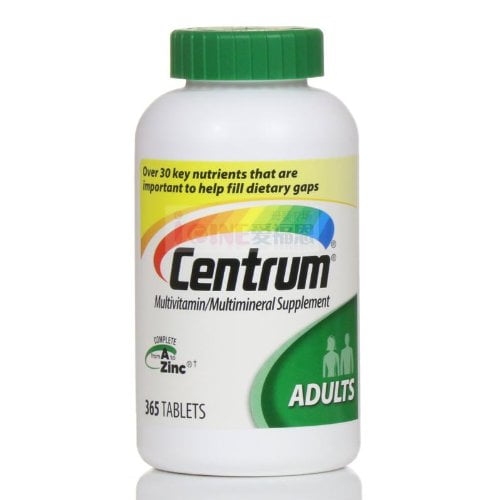
Centrum Adult Multivitamin is a complete multivitamin/multimineral supplement formulated for adults. This daily multivitamin for adults contains 23 micronutrients, including Vitamin D3. These adult vitamins also contain B Vitamins and iron to help support daily energy levels and assist with the metabolism of macronutrients, and antioxidant Vitamins C and E, and zinc for immune support . Centrum adult multivitamins contain 100 percent or more of the daily value of iron, Vitamin D3 and Vitamin B12. These multivitamins for adults are also Non-GMO and gluten free vitamins to appeal to a variety of dietary needs.

These vitamin tablets feature a smooth coating that makes them easy to swallow. With 300 multivitamin tablets per bottle, it's easy to maintain your overall health by taking one of these vitamins for men and women daily with food . Help support full body wellness with Centrum multivitamins, the #1 doctor and pharmacist recommended brand. These statements have not been evaluated by the Food and Drug Administration.

This product is not intended to diagnose, treat, cure or prevent any disease. Non-GMO applies to Centrum and Centrum Silver tablets only; learn more at Centrum's official website. Effective from 9 March 2021, all healthcare service providers who determine pursuant to Art. I for the presence of the SARS-CoV-2 virus with a positive result, are ordered to inform the locally competent public health protection authorities of this fact without undue delay. Furthermore, investigators define MVMs differently in their studies to evaluate the potential health effects of these products.
For example, the Agency for Healthcare Research and Quality, in an evidence-based review of the role of MVMs in chronic disease prevention, defined MVMs as products containing at least three vitamins and minerals in amounts below the UL but no herbs, hormones, or drugs . One team of researchers categorized MVMs more ambiguously as "stress-tab-type," "therapeutic type," and "one-a-day type," so these products probably included MVs as well . Another team defined MVMs as "full-spectrum" products providing all 12 vitamins plus 10 minerals . Some published reports of studies of dietary supplements use the generic term "multivitamins" to include products with and without minerals. Various government surveys of dietary supplements and popular food-frequency questionnaires also define MVs and MVMs differently, include different examples, or ask about different products.

Centrum Adult Multivitamin is a complete multivitamin/multimineral supplement for adults, with key micronutrients to feed your cells and help support your energy, immunity and metabolism. With Centrum's highest levels of vitamin D3, a preferred form of vitamin D, these adult multivitamins help fill nutritional gaps and promote whole body health. These non GMO, gluten free vitamins contain antioxidant vitamins C, E and zinc for immunity support. Each adult vitamin tablet also delivers vitamin B and iron as energy supplements and to aid in the metabolism of fats, carbohydrates and proteins. Support your body head to toe by taking one tablet with food every day. Feed your cells, fuel your life with Centrum, the #1 doctor and pharmacist recommended brand.

The school shall immediately inform the relevant regional public health authority by telephone or e-mail of the fact established pursuant to point 1. The regional public health authority shall carry out an epidemiological investigation, including a risk assessment, and take adequate anti-epidemic measures to prevent the spread of the disease. Besides that, people who skimp on servings from one or more food groups and eliminate certain foods, such as gluten from their diets, can also benefit from dietary supplements.

Even women in their childbearing years and people over 50 that may be at risk for vitamin and mineral deficiencies are also recommended to consume good multivitamins such as Centrum Multivitamins. These multivitamins can fill gaps in nutrient intake that could result in chronic conditions, including osteoporosis, birth defects, anemia, and others. In the event this fact cannot be reported to any of the providers stated in the first sentence, this fact will be reported to the Regional Public Health Authority which holds jurisdiction.

Overall, MVMs do not appear to reliably reduce the risk of chronic diseases when people choose to take these products for up to a decade or when studies randomize people to take them as part of a clinical trial. Preventive Services Task Force reviewed the existing clinical trial data and concluded that only "limited evidence" supported any beneficial effect of MVMs on the risk of cancer or heart disease in healthy people without known nutrient deficiencies . In 2021, after another review of studies published since 2013, the USPSTF concluded that the evidence is still insufficient to weigh the benefits and harms of MVM use to prevent CVD or cancer .
The American Institute for Cancer Research recommends against taking dietary supplements for cancer prevention because supplements do not provide the same benefits as eating whole foods . Similarly, the American Heart Association advises against the use of MVMs to prevent CVD because scientific studies have found them to be of no value for this purpose . Know that multivitamins shouldn't take the place of whole foods and a healthy diet. Fresh produce, lean protein, and fortified grains are chock full of natural enzymes and nutrients that you won't find in man-made vitamins.

But, vitamin supplements can fill in any nutritional gaps you don't get in your diet. For instance, adult women between the ages of 19 and 50 need 18 milligrams of iron each day, while men only need about 8 mg, according to dietary guidelines from the National Institute of Medicine. If your diet doesn't contain iron-rich foods like red meat, fortified grains, or beans, a multivitamin may be a good way to get the recommended daily intake. Large clinical trials have found that taking vitamins and mineral supplements, including multivitamins, doesn't lower the risk of disease compared with not taking a multivitamin.

Most recently, researchers from the Women's Health Initiative, who tracked more than 161,000 women, concluded that women who took the pills had no lower risk of cancer, cardiovascular disease, or death from any cause over an eight-year period than those who didn't. The healthcare service provider or public health protection authority that was notified about the positive result of a test pursuant to Art. I is obliged to issue an order form to the person specified in Art. I without delay for performance of an RT-PCR test confirmation test to examine him/her for the presence of the SARS-CoV-2 virus.
Effective from 9 March 2021, all healthcare and social service providers who perform preventive examinations to determine the presence of the SARS-CoV-2 virus antigen using POC antigen tests pursuant to Art. II are ordered to report, electronically and without undue delay, information about every POC antigen test result or subsequently performed RT-PCR confirmation test pursuant to Art. I to determine the presence of the SARS-CoV-2 virus in a tested person pursuant to Art. Other RCTs have evaluated the effects of MVMs on outcomes in individuals with a range of chronic diseases.

One RCT conducted in Linxian, China, randomized 3,318 persons ages 40–69 years who had precancerous lesions in the esophagus to receive a daily MVM containing 14 vitamins and 12 minerals in doses 2 to 3 times recommended amounts or a placebo for 6 years . The supplement did not reduce incidence or mortality rates for esophageal cancer or the rate of mortality from any cause. This fact sheet by the National Institutes of Health Office of Dietary Supplements provides information that should not take the place of medical advice.

We encourage you to talk to your healthcare providers (doctor, registered dietitian, pharmacist, etc.) about your interest in, questions about, or use of dietary supplements and what may be best for your overall health. Any mention in this publication of a specific product or service, or recommendation from an organization or professional society, does not represent an endorsement by ODS of that product, service, or expert advice. Centrum MultiGummies are multivitamins containing several of the essential vitamins and minerals your body needs. Therefore, these products should not be taken with any other multivitamin products.

We recommend always checking with your healthcare professional about the best regimen to follow for your dietary supplement needs. A mandatory part of the reported information about the result of the POC antigen test is information about whether the patient is symptomatic or asymptomatic. In the case of persons who are themselves healthcare service providers or social service providers, Articles I to VI shall apply mutatis mutandis. E) undergo preventive testing under this extraordinary measure with another employer who is a healthcare service provider or social service provider, and provide proof of this to the employer by written confirmation from that other employer. The DGA does not mention MVMs, but it does recommend that Americans choose healthy, nutrient-dense food and beverages.
The DGA lists nutrients of special public health concern in American diets, such as calcium, potassium, dietary fiber, and vitamin D in both adults and children. Iron is also a nutrient of public health concern for infants ages 6–11 months who are fed primarily human milk and do not consume enough iron from complementary foods, adolescent females, and people who are pregnant. Depending on their formulations, MVMs can help individuals obtain adequate amounts of these nutrients, except for potassium and dietary fiber. Basic MVMs contain both vitamins and minerals, most in amounts that do not exceed the DVs.

However, MVMs often have small amounts of certain nutrients, such as calcium, magnesium, and potassium, so supplement users should check product labels. When choosing an MVM product, consumers should consider taking a product designed for people of their age, sex, and life stage (e.g., pregnancy). MVMs for "senior" men and women, for example, often contain little or no iron and more calcium, vitamin D, and vitamin B12 than MVMs for younger adults . Prenatal supplements generally provide no vitamin A in the form of retinol, and most children's MVMs provide age-appropriate amounts of nutrients.

One of the largest prospective studies of MVM use was the Women's Health Initiative, which evaluated the health of 161,808 postmenopausal women aged 50–79 years and their risk factors for cancer, heart disease, and osteoporosis. A total of 41.5% of the women took an MVM (containing 20–30 vitamins and minerals in amounts not exceeding the RDAs), an MV (10 or more vitamins in amounts of 100% or more of the RDA), or a "stress multisupplement" at least once a week. When the investigators compared the outcomes of supplement users and nonusers, they found no association between use of these products for a median of 8 years and an increased risk of any common cancer or total cancers, CVD, or total mortality . Investigators who followed a multiethnic cohort of 182,099 men and women aged 45–75 years living in Hawaii and California for an average 11 years found similar results . Approximately 48% of the men and 52% of the women in this study reported taking an MV or MVM. For people who don't get all the vitamins and minerals they need from a healthful diet , a multivitamin may seem like a cheap, easy way to reap the same benefits.

Trouble is, getting your nutrients from pills isn't the same as getting them from food. That's because fruits, vegetables, whole grains, and other plant foods contain thousands of beneficial plant substances called phytochemicals that interact with one another in myriad ways, some of which scientists may not even understand yet. The greater the food variety, the more numerous the potential beneficial interactions. Taking the vitamins and minerals out of food robs you of all those healthful interactions, not to mention fiber, a disease fighter in its own right. That may be why study after study of isolated, high doses of vitamins has found they failed to prevent cancer, dementia, heart disease, or type 2 diabetes, even though people who eat foods rich in those vitamins have lower rates of those diseases.
All of the products met their claimed levels of vitamins A, C, D, and E, folic acid, riboflavin, calcium, iron, and zinc; lacked worrisome levels of heavy-metal contaminants; and dissolved adequately in the U.S. All had a safety seal on the mouth of the bottle and, unless otherwise noted, a child-resistant cap. Unless otherwise noted, all adult and children's formulations contain iron; the senior formulations do not. USP verified indicates that a product has been verified for purity, strength, safety, dissolvability, and manufacturing quality by the USP, an independent standards-setting authority for the drug and dietary supplement industries. USP claim indicates that the manufacturer claims the product was made to one or more of the USP's quality standards or specifications, but the claim is not vetted by the USP. The verification seal holds more weight than a USP claim on the label, which several of the other products we tested had.
An employer who is a school, school facility as referred to in Art. I or a school canteen or school canteen-dispensary, which provides school meals to the children, pupils or students under Art. I, shall only allow its employees to be present in person at the employer's workplace if the employee proves one of the facts referred to in Art. In the event of a positive result of a test undergone on the spot, Art.

Deciding if you need to add a multivitamin to your vegan diet? Not only is this decision totally personal, there's no one-size-fits-all approach. Some plant-based eaters choose to take a complete multivitamin that covers all their bases and some opt for a vitamin supplement specifically made with nutrients that may be missing on a vegan diet, such as omega-3 fatty acids, vitamins B12 and D, calcium, iodine, iron, and zinc. In your vitamin shopping, it's important to note that not all vitamins are vegan—some contain gelatin or use nutrients derived from animal sources. For a lineup of plant-based supplements, check out our list of the 14 best vegan multivitamins for your diet.

MVMs providing nutrients in recommended amounts do not ordinarily interact with medications, with one important exception. People who take certain blood thinners, such as warfarin , should talk with their healthcare providers before taking any MVM or dietary supplement containing vitamin K . Vitamin K is involved in blood clotting and decreases the effectiveness of warfarin and similar drugs. Healthcare providers determine the dose of this medication for a given patient in part by assessing the amount of vitamin K that the patient routinely consumes. The American College of Obstetricians and Gynecologists recommends that pregnant people take a daily "prenatal vitamin" .

Acknowledging that most healthcare providers recommend that pregnant people take a daily prenatal MVM, the DGA states that this practice may be necessary to meet the needs for folate or folic acid, iron, iodine, and vitamin D during pregnancy . The DGA also states that pregnant people might need to take separate supplements of iodine and choline when their healthcare provider recommends that they do so because many prenatal MVMs do not contain these nutrients or contain only small amounts of them. The report recommends that people following a vegetarian or vegan diet consult their healthcare provider about whether they need supplementation with iron, vitamin B12, and other nutrients (e.g., choline, iodine, EPA, and DHA). The World Health Organization recommends iron and folic acid supplementation throughout pregnancy . Some evidence from RCTs has focused on the use of MVMs to reduce the risk of various chronic diseases. Use of MVs and MVMs (products containing three or more vitamins and/or minerals in amounts below the ULs and no herbs) did not reduce the risk of any chronic disease.

A cross-sectional analysis of a nationally representative sample of 1,003 pregnant U.S. people aged 20 to 40 years from the 2001–2014 NHANES found that many consumed less than recommended amounts of many nutrients from diet alone . Among the 69.8% who took a dietary supplement , the risk of inadequate intakes of many nutrients was lower. For example, 27.7% had inadequate intakes of vitamin A from foods alone, but this rate dropped to 15.5% when supplements were included. However, supplement use increased the proportion of pregnant people with some intakes of iron (27.9%) and folic acid (33.4%) above the UL. Multivitamins, including Centrum products, are generally safe.
What Age Can Take Centrum However, most people don't need to take multivitamins or dietary supplements. Any multivitamin can be toxic when consumed in excessive quantities. If you choose to consume a dietary supplement, make sure you only consume the recommended amount. As a part of educational activities whose character does not enable the wearing of a protective device , the teacher who does not meet the conditions under point 1 must maintain a distance of at least 1.5 meters from others. The extraordinary measure of the Ministry of Health that stipulates the wearing of respiratory protective equipment and exceptions to this shall not apply to an employee who does not meet any of the conditions under point 1 for the period of performing their activity.

This provider shall order the child, pupil or student to be isolated. Centrum Adult is the perfect multivitamin that is formulated to support busy adults that require help in maintaining a balanced diet and hectic work schedules. With high levels of vitamin D, Centrum Adults has more vitamin D3, a preferred form of vitamin D. Key nutrients like iron, Vitamin B, C, E, Beta-Carotene, and Zinc can help support your energy, immunity, and metabolism. There are 30 key nutrients important for your body to help fill nutritional gaps in one capsule; Centrum Adult is your perfect health companion.

Although health experts favor food for meeting vitamin and mineral needs, many people cannot fulfill the required daily nutrients. Therefore, vitamins and mineral supplements now play a new role in helping support our daily diet. Keep in mind that they are not substitutes for a balanced eating plan.

You can't take a vitamin C tablet and not eat fruits or vegetables at all; tablets are only supplements. That said, over-consuming vitamins may also bring more harm than good. So, it is important to learn about your daily dietary needs and select suitable supplements that will complement your dietary needs.
A few studies suggest that multivitamins may even increase the risk of certain health problems. Most recently, a highly publicized Swedish study that tracked some 35,000 women over 10 years found that those who took multivitamins were slightly more likely to be diagnosed with breast cancer than those who didn't take the supplements. That doesn't mean the multivitamins increased the women's risk of cancer; it may be that the women who took them were less healthy in other ways that increased their likelihood of developing cancer.



No comments:
Post a Comment
Note: Only a member of this blog may post a comment.